

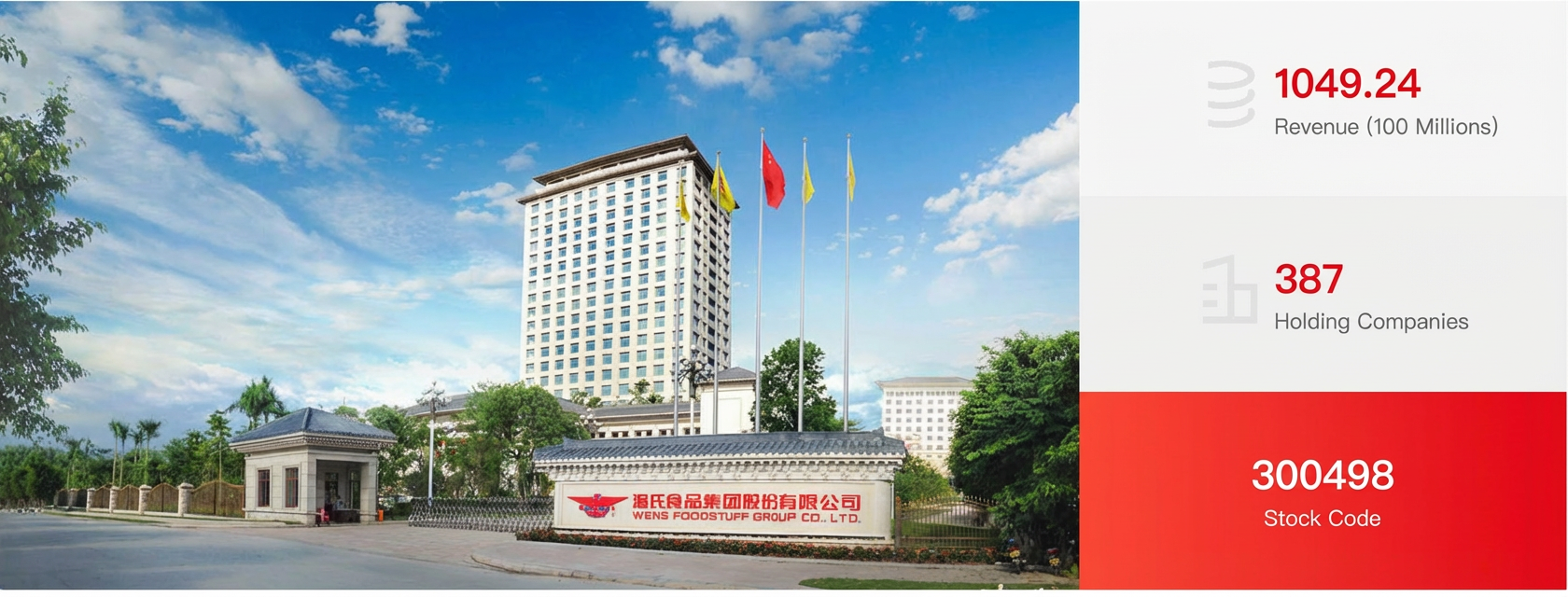
Wens Foodstuff Group Co., Ltd. (hereafter Wens Group) is a leader in China's agricultural industry. With a dedicated R&D and IT team, the company is committed to using technology to improve production efficiency and management in agriculture and animal husbandry. Its technical team plays a pivotal role in driving the group's digital transformation and building its smart agriculture and animal husbandry platform.
 With rapid business expansion and a growing engineering team, the R&D division faced multiple challenges in efficiency, quality, and velocity during its digital transformation. These challenges were particularly pronounced in the digital upgrade of traditional sectors like agriculture and animal husbandry.
The R&D team spent significant time on repetitive, boilerplate coding, which slowed development and constrained engineers' creativity. This was especially true during the digital transformation of the agriculture and animal husbandry sectors, which involved extensive development of data models, business rules, and front-end interfaces that consumed a great deal of engineering time.
With rapid business expansion and a growing engineering team, the R&D division faced multiple challenges in efficiency, quality, and velocity during its digital transformation. These challenges were particularly pronounced in the digital upgrade of traditional sectors like agriculture and animal husbandry.
The R&D team spent significant time on repetitive, boilerplate coding, which slowed development and constrained engineers' creativity. This was especially true during the digital transformation of the agriculture and animal husbandry sectors, which involved extensive development of data models, business rules, and front-end interfaces that consumed a great deal of engineering time.
New hires were slow to onboard, the team struggled to maintain consistent coding standards, and the burden of code review was high. As the group's business and technical teams grew, training new employees quickly while ensuring code quality and standards became a major management challenge.
Rapid product iteration cycles required generating high-quality code faster. To respond effectively to fast-changing market and business needs, the group needed to shorten its R&D cycles and increase its competitive edge.
In response, Wens Group integrated Qoder CN Dedicated Edition across its R&D workflow as an AI programming assistant to improve development efficiency, code quality, and team collaboration. Wens Group applied Qoder CN in five core use cases covering the entire software development lifecycle, achieving end-to-end efficiency improvements from coding assistance to intelligent diagnostics:
Wens Group used Qoder CN to analyze the query interface for split-order delivery notes in its retail and wholesale platform. After the team uploaded the interface code and database table schema, Qoder CN automatically parsed the SQL execution plan, identified three performance bottlenecks, and generated index optimization recommendations and a rewritten SQL query.
Core results:
The team used Qoder CN with the EAS system's XML-based BOTP conversion rules to generate a mapping table for upstream and downstream document fields. This converted multi-layered, nested XML rules into an intuitive Excel spreadsheet and automatically translated technical formulas (such as the logic in the _BOT_getPayExpFromReceiptsExp function) into business rules described in natural language.
Core results:
Qoder CN automatically extracted three types of constants—MainEntity, SubEntity, and SubEntityFields— and grouped them by functional module with standardized comments. It also supported custom naming rules, such as automatically converting wens_genetics from XML to the WENS_GENETICS constant.
Core results:
The team used Qoder CN to generate SQL for customer balance detail reconciliation. This enabled multi-dimensional data statistics covering eight transaction types, such as customer deposits, withdrawals, and transfers. The solution supports three-level grouping by customer type, transaction method, and organizational unit, and it automatically handles complex calculation logic for opening balances, sales amounts, and discounts.
Core results:
"Qoder CN has become an indispensable AI programming assistant for our technical team at Wens Group. It has not only dramatically boosted our development efficiency, allowing our engineers to focus on more valuable and innovative work, but has also provided a powerful technological boost to our digital transformation by enhancing code quality and standardization."
—— Kuang Yingjie, Head of IT, Wens Group

New hires were slow to onboard, the team struggled to maintain consistent coding standards, and the burden of code review was high. As the group's business and technical teams grew, training new employees quickly while ensuring code quality and standards became a major management challenge.
Rapid product iteration cycles required generating high-quality code faster. To respond effectively to fast-changing market and business needs, the group needed to shorten its R&D cycles and increase its competitive edge.
In response, Wens Group integrated Qoder CN Dedicated Edition across its R&D workflow as an AI programming assistant to improve development efficiency, code quality, and team collaboration. Wens Group applied Qoder CN in five core use cases covering the entire software development lifecycle, achieving end-to-end efficiency improvements from coding assistance to intelligent diagnostics:
- Intelligent code completion and comment generation: Qoder CN provides real-time code suggestions and automatically generates comments for functions, classes, and modules, significantly improving coding efficiency and code readability.
- R&D acceleration: It offers real-time assistance for tasks such as interface development, business logic implementation, entity class creation, front-end code generation, and SQL script generation, reducing manual coding efforts.
- Code optimization and issue diagnosis: Qoder CN analyzes code for performance bottlenecks, identifies slow SQL, and suggests optimizations. It quickly pinpoints the root cause of interface exceptions and provides suggested fixes, dramatically reducing troubleshooting time.
- Business logic clarification and conversion: Qoder CN translates complex business rules (such as an EAS system's XML-based BOTP conversion rules) into an intuitive mapping table. It also automatically translates technical formulas into natural language descriptions, making the business logic easier to understand.
- Standardization and automation: It automatically generates standardized Java constant classes, configuration files, and other boilerplate code, ensuring consistency in naming and structure while reducing team communication overhead.
| Dimension | Wens Group AI-generated code percentage | Qoder CN code generation percentage (referred to as adoption rate by Wens) |
|---|---|---|
| Definition | Lines of AI-generated code adopted in the month / Total effective lines of code committed to Git | Lines of code accepted (totalLinesAccepted) / Lines of code changed (totalLinesChanged) |
| Numerator | Lines of AI-generated code adopted in the month | Lines of code accepted on the day (including ask, edit, agent Q&A, and inline completions) |
| Denominator | Total effective lines of code committed to Git | Lines of code changed on the day (including ask, edit, agent Q&A, and inline completions) |
| Time dimension | Monthly statistics | Daily/Monthly statistics |
| Scope | All code committed to Git | Only code changes within the Qoder CN tool (plugin) |
| Participants | All developers (including those not using Qoder CN) | Only developers using Qoder CN |
| Typical value | 12% | Typically higher |
Key results
Use case 1: Significant interface performance optimization
Wens Group used Qoder CN to analyze the query interface for split-order delivery notes in its retail and wholesale platform. After the team uploaded the interface code and database table schema, Qoder CN automatically parsed the SQL execution plan, identified three performance bottlenecks, and generated index optimization recommendations and a rewritten SQL query.
Core results:
- Query response time reduced from 3 seconds to 0.6 seconds
- Database CPU usage reduced by 45%
- Generated 5 index optimization statements, which the team validated in the production environment
Use case 2: Increased document conversion efficiency
The team used Qoder CN with the EAS system's XML-based BOTP conversion rules to generate a mapping table for upstream and downstream document fields. This converted multi-layered, nested XML rules into an intuitive Excel spreadsheet and automatically translated technical formulas (such as the logic in the _BOT_getPayExpFromReceiptsExp function) into business rules described in natural language.
Core results:
- Mapped 132 fields, reducing the error rate from 18% to 0.The team used Tongyi Lingma's intelligent chat to clarify the field mapping from an accounts receivable document to the target document. The mapping was divided into header fields and entry fields. Header fields included org (organization), srcBillName (source bill name), description, sourceBillId (source bill ID), company (business partner), currency, bizDate (business date), id (document ID), and business partner type. Entry fields included counter account, expense type, amount payable, amount payable in local currency, exchange rate, currency, remarks, cost center, and entry ID. Some mapping rules included conditional logic, such as determining the counter account value based on an expense type code.
Use case 3: More efficient constant class generation
Qoder CN automatically extracted three types of constants—MainEntity, SubEntity, and SubEntityFields— and grouped them by functional module with standardized comments. It also supported custom naming rules, such as automatically converting wens_genetics from XML to the WENS_GENETICS constant.
Core results:
- The time to generate 800 lines of code fell from 2 hours to 5 minutes.
-
Achieved 100% consistency in constant naming, reducing communication costs for cross-team collaboration.
Use case 4: Accelerated financial reconciliation data processing
The team used Qoder CN to generate SQL for customer balance detail reconciliation. This enabled multi-dimensional data statistics covering eight transaction types, such as customer deposits, withdrawals, and transfers. The solution supports three-level grouping by customer type, transaction method, and organizational unit, and it automatically handles complex calculation logic for opening balances, sales amounts, and discounts.
Core results:
- Processing time for 802 reconciliation data entries fell from 4 hours to 15 minutes.
- The manual calculation error rate dropped from 12% to 0.
- Troubleshooting efficiency improved significantly: interface exception investigation time dropped from 90 minutes to 10 minutes, and the tool provided multiple suggested fixes.
Qualitative impact
- Engineers can focus on core business logic and innovative work, such as optimizing smart farming algorithms and analyzing agricultural big data.
- The team's coding style has become more unified, improving code quality and reducing potential bugs and maintenance costs.
- This has accelerated iteration and delivery cycles for the smart agriculture and animal husbandry platform and various business systems, strongly supporting the group's digital transformation strategy.
- Qoder CN has evolved from a supplementary tool into a key productivity driver for the Wens technical team, becoming an essential AI programming assistant for every engineer.
Customer testimonial
"Qoder CN has become an indispensable AI programming assistant for our technical team at Wens Group. It has not only dramatically boosted our development efficiency, allowing our engineers to focus on more valuable and innovative work, but has also provided a powerful technological boost to our digital transformation by enhancing code quality and standardization."—— Kuang Yingjie, Head of IT, Wens Group