


Qoder's native code security capability is now available. Qoder and Qoder CLI are the first to support this capability. Other Qoder products will follow in subsequent releases.
The Faster You Develop, the Earlier Security Checks Should Happen
AI Coding is accelerating code generation and software iteration, requiring teams to review more code changes in less time. Meanwhile, AI is also accelerating vulnerability discovery and exploitation, quickening the pace of software attack and defense.
If security checks only happen before testing or release, key context is often difficult to reconstruct by the time issues are reported back to developers. Qoder moves security checks forward to the development stage, enabling developers to discover issues while they still have familiarity with the code context, making it easier to locate root causes and complete fixes.
Three-Layer Scanning Covering Key Development Stages
Different development stages require different depths of security checking. Qoder uses a progressive three-layer scanning mechanism to balance feedback speed and analysis depth.
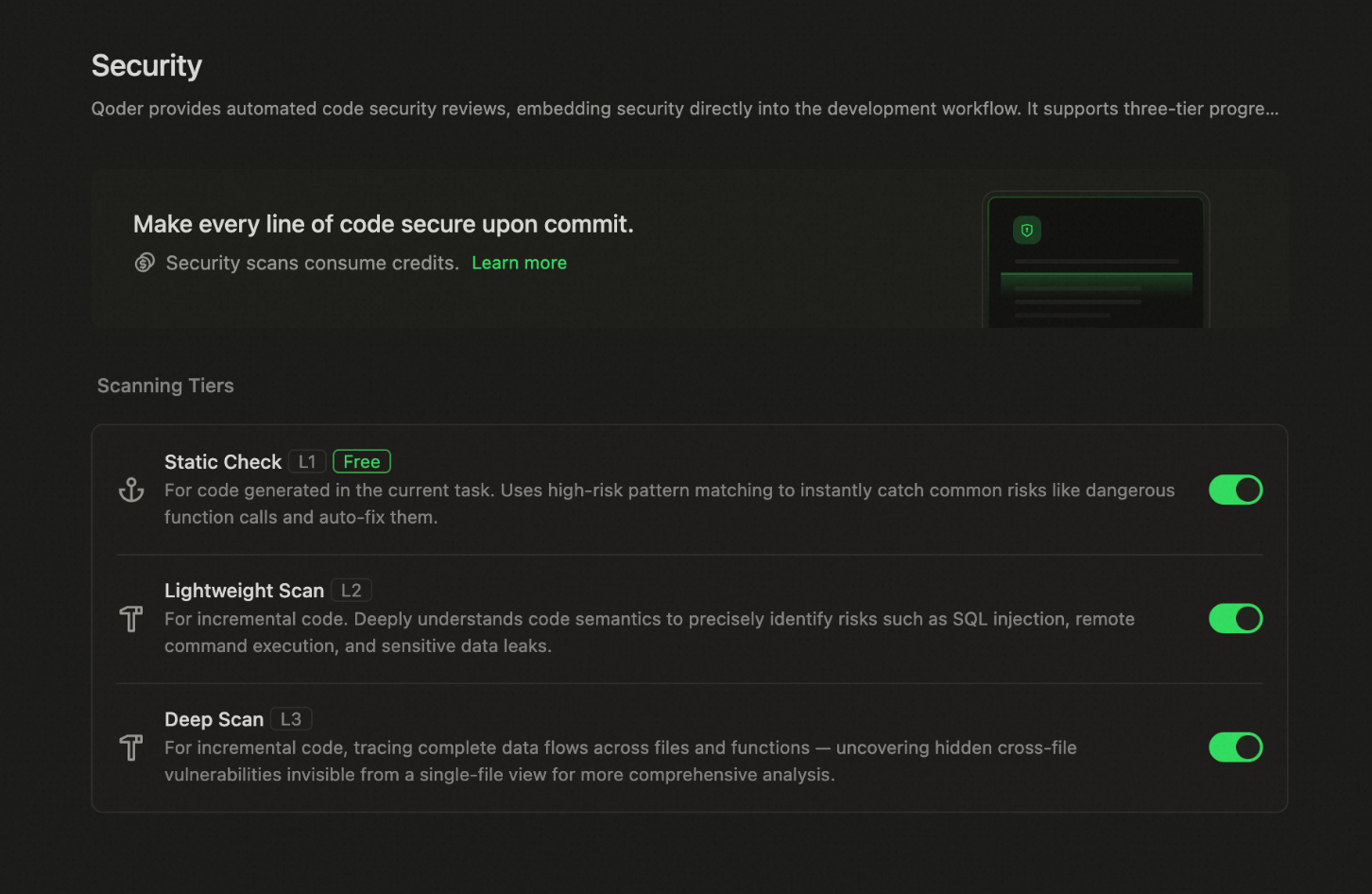
L1 Static Scan: Flag Obvious Risks During Coding
Using lightweight pattern matching, it identifies high-risk function calls that could lead to vulnerabilities such as command injection, providing timely alerts during coding without disrupting the development flow.
L2 Lightweight Scan: Assess Change Risk with Context
Qoder performs semantic analysis on current code changes, combining input sources, usage patterns, and local context to identify issues that pattern matching alone cannot determine. This type of check is suitable for running after completing a round of code modifications, enabling timely discovery and remediation.
L3 Deep Scan: Trace Cross-File, Cross-Function Data Flows
Tracks the complete path of data from entry points to sensitive operations across a broader scope, identifying complex risks that are difficult to detect in a single file and can only be discovered through cross-file analysis. Suitable for more thorough checks before code commits or change merges.
Beyond Finding Risks — Helping Developers Complete Fixes
- Understanding code context. Qoder analyzes external inputs, field semantics, function call relationships, and data flow, explaining how issues arise, how data flows, and at which stage risks are ultimately exposed.
- Multi-Agent collaborative review. Multiple Agents cross-review initially discovered risks from different angles, reducing false positives from single assessments and providing more substantial evidence for finally confirmed risks.
- Providing reviewable remediation plans. Qoder explains issues and key data flows, and provides targeted remediation suggestions. After developers confirm the suggestions, Qoder Agent can assist with code modifications; the results still need to be reviewed and confirmed by developers.
Currently Covered Risk Types
Currently, Qoder code security focuses on detecting SQL injection, command injection, path traversal, sensitive information exposure, improper use of cryptographic methods, and insecure deserialization.
Privilege escalation, authentication flaws, and business logic vulnerabilities are highly dependent on specific business context and are not currently within the primary coverage scope. Related detection capabilities will be progressively enhanced as models and analysis techniques evolve.
Qoder code security aims to help teams discover risks earlier and fix issues, but cannot replace necessary code reviews, testing, and professional security audits. Remediation suggestions must be adopted after developer review, and code changes must also be reviewed and confirmed by developers.
User Practices
Learn how Qoder code security works in real projects and development workflows:
- User practices: Qoder Security User Practices
Getting Started
Let security start from the first line of code. Qoder code security is currently available through the following products:
- Qoder IDE guide: Qoder IDE Security
- Qoder CLI guide: Qoder CLI Security